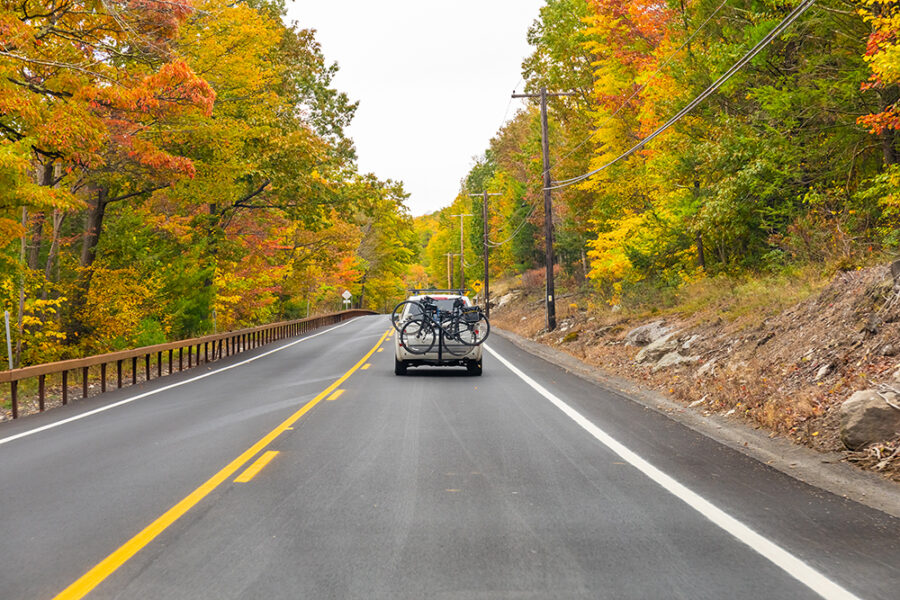

You’re heading north on Route 1 somewhere between Damariscotta and Camden. You loosen your grip on the wheel for a second and the car eases toward the shoulder. Later that afternoon you run I-295 down to Portland and the same car tracks arrow straight for forty minutes. Nothing was adjusted in between. Nothing was replaced.
Most advice about a car pulling to the right hands you a checklist of symptoms and tells you to book service. That’s backwards. The more useful question isn’t what the car is doing but where it’s doing it. Answer that first and you’ll often save yourself an appointment, or show up to one already knowing exactly what to describe.
This post walks through that location test, explains why a healthy car drifts right on plenty of Maine roads, and covers the symptoms that genuinely do call for a wheel alignment Midcoast Maine drivers can trust.
Start With the Road, Not the Car
Pavement isn’t flat. It isn’t supposed to be.
Roads are built with a crown so rainwater runs off the surface instead of sitting on it. According to the Texas Department of Transportation’s roadway design manual, the standard pavement cross slope for usual conditions is 2 percent, and it should not be less than 1 percent on any roadway. The stated purpose is drainage, specifically keeping water from ponding on flat stretches of uncurbed pavement. In a place that gets Maine’s rainfall and snowmelt, that slope earns its keep.
The geometry matters for what your car does. On an undivided road with a lane in each direction, the high point of the crown sits in the center of the pavement and the surface slopes away toward both edges. So the right-hand lane, the one you’re driving in, tilts down toward the right shoulder.
A car sitting on a surface that tilts right will tend to move right. That’s not a defect. That’s gravity on a road doing exactly what it was designed to do.
This is the most common false alarm we hear at our stores from Belfast to South Portland. A driver notices a drift on a two-lane road, assumes something is broken, and walks in braced for bad news. Often the honest answer is that the car is fine and the road is sloped.
The Location Test: Route 1 Versus I-295
Here’s the diagnostic that costs nothing and takes an afternoon.
Drive the car on two genuinely different kinds of road the same day, with the same tires, the same load, and the same weather. A crowned two-lane like much of Route 1 through the Midcoast is one. A wide, divided, well-drained highway like I-295 is the other. Then compare.
- The drift changes or disappears when the road changes. Strong sign the pavement is the cause. The variable that moved was the road, not the vehicle.
- The pull is identical on both. Now the car is the common factor, and the car is worth investigating.
Add the lane-change test where it’s safe and legal to do so. On a multi-lane road, your position relative to the crown changes as you move over. A drift caused by pavement slope will change character, sometimes easing, sometimes flipping direction entirely. A pull that comes from the vehicle doesn’t care which lane you’re in. It behaves the same everywhere.
Then reverse your direction and drive the same stretch of Route 1 the other way, south toward Bath and Brunswick instead of north toward Belfast. Road crown pushes you toward the right shoulder in both directions, because you’re in the right-hand lane both times. A pull that stays fixed to one side of the car rather than one side of the road is telling you something different.
None of this requires tools. It requires paying attention to one variable at a time.
Drift Versus Pull, and Why the Difference Matters
Technicians draw a distinction most drivers don’t, and it’s worth borrowing.
The manufacturer diagnostic procedure for this exact complaint separates two conditions. A drift is the vehicle moving sideways without active steering input, wandering gently. A pull is the vehicle actively steering itself, so you have to apply and hold steering input to keep it going straight. The procedure notes these have different root causes, which is why lumping them together as “it pulls” leads people to the wrong conclusion.
Test it, only where it’s safe: a quiet, straight, empty stretch, hands ready on the wheel, no traffic near you. A light, lazy wander toward the shoulder is a drift. A car that noticeably steers itself and needs steady counter-pressure from your arms is a pull. The second one points at the vehicle.
The same procedure tells technicians to road test on a smooth, level road with minimal traffic, and there’s even a purpose-built Road Crown Gauge, a dedicated special tool, for measuring and accounting for road crown during diagnosis. The people who engineered the car treat crowned pavement as a variable that has to be neutralized before anyone blames the alignment. If the factory procedure rules out the road first, that’s a good habit for a driver to copy.
The Symptoms That Really Are Alignment
Once the road is ruled out, a short list of signs points squarely at alignment. These are the ones worth acting on.
- The steering wheel sits off center while the car tracks straight. You’re cruising down I-295 dead straight, and the logo in the middle of your steering wheel is noticeably rotated. No road slope explains that. The car is holding a straight line while its steering is referenced to the wrong point, which is a geometry problem.
- The pull is identical everywhere. Both roads, both lanes, both directions, same strength. The road changed and the behavior didn’t.
- The tires are wearing unevenly across the tread. Run your hand across each front tire from inside edge to outside edge. If one edge is visibly lower than the rest of the tread, the tire isn’t meeting the road squarely. That’s toe or camber leaving a physical record on the rubber, and unlike a feeling in the steering wheel, it doesn’t go away once you get used to it.
- The behavior is new. A car that has drifted mildly on Route 1 for six years is probably just a car on Route 1. A car that started tugging three weeks ago has changed, and something caused that change.
That last one is where Maine comes into the story.
What Maine Frost Heaves Actually Do to Your Alignment
As WGME has explained, the damage starts with water. It seeps into cracks in the pavement, collects beneath the surface, and softens the road base. When the temperature drops below freezing overnight, that trapped water freezes and expands, pushing the pavement upward. The bump you feel is a frost heave. Then spring arrives, the frozen pockets melt, the pavement is left without support underneath, and the constant weight of passing traffic collapses the surface. That’s where potholes come from. Lightly traveled back roads are especially vulnerable, which is a fair description of a lot of Midcoast driving.
MaineDOT treats this as seriously as any driver should. Each spring the department evaluates state and state-aid highways and imposes weight restrictions to prevent freeze-thaw damage, on the reasoning that spring weight restrictions protect roads during thawing conditions, when they are most fragile. MaineDOT even publishes a Cumulative Thawing Index map showing where the ground is beginning to thaw and where roads may become vulnerable. When the state is posting roads to keep heavy trucks off them, that’s a strong hint about what those same roads are doing to a passenger car at speed.
Here’s the connection to your steering. A hard hit into a frost heave or a pothole is an impact load fed straight into the steering and suspension components that hold your wheel angles in place. Enough force in the wrong place and those angles move. Checking alignment after frost heaves have chewed up the back roads is one of the most common reasons a car that behaved perfectly in January starts tugging in April, and it’s why our Hallowell and Damariscotta stores get busy the moment the ground starts letting go.
The timeline can be misleading, too. A Brunswick commuter might hit a bad one in March, feel nothing unusual for two weeks, and only later notice the car tugging on every road surface with the inside edge of a front tire going bald. The strike and the symptom don’t always arrive together, so the connection is easy to miss. A hard enough hit can also take the tire itself out on the spot, which is a different problem with its own roadside checklist.
The Winter Tire Swap: Usually the Tires, Not the Alignment
Maine law makes the twice-a-year changeover close to universal here. Under Title 29-A, Section 1919 of the Maine Revised Statutes, from the first day of May to the first day of October a vehicle may not be operated with tires having metal studs, wires, spikes, or other metal protruding from the tread. Two swaps a year, every year, for anyone running studs.
So a very common call sounds like this: the winter tires went on in late October, and now the car pulls, and it didn’t pull last week.
Be clear about what a swap can and cannot do. Taking wheels off and bolting them back on does not change your alignment settings. Toe and camber are properties of the suspension, set by the parts that locate the wheel, and a wheel change doesn’t touch that geometry. Anyone who tells you the tire swap knocked your alignment out is skipping a step.
What actually causes a post-swap pull is usually the tires and wheels themselves:
- Inflation pressures set differently across an axle. Different pressures left and right can produce a pull all by themselves.
- Uneven wear on the set that has been in storage. Those tires kept whatever wear pattern they had when they came off last season, and now you’re feeling it again.
- A rim bent in a pothole the previous spring. It went into storage damaged and it comes out of storage damaged.
- A real difference between the two sets of tires. Construction differences between one set and another can produce a slight steering bias that is entirely a tire characteristic.
The practical takeaway is that the changeover is the ideal moment to have alignment checked. Not because the swap caused a problem, but because the wheels are already off, the tires are in hand for inspection, and it’s the one appointment nearly every Maine driver keeps twice a year anyway. If you’re already planning your studded tire swap around the legal window, it makes sense to handle both in one visit.
When to Book a Wheel Alignment Check in Midcoast Maine
You don’t need to guess. These are the moments worth booking:
- After a hard pothole or frost heave strike, particularly during and just after the spring thaw.
- At your seasonal tire changeover, when the wheels are already coming off.
- Any time new tires go on, so they start their life wearing evenly.
- When the location test says the behavior follows the car rather than the road.
- When you find uneven wear across the tread of a front tire.
- When the steering wheel is off center on straight, level pavement.
A proper check measures your actual angles against the manufacturer’s specification and tells you whether they’re in range. Sometimes the answer is that everything is in spec and the pull is coming from tire pressure or a damaged wheel, which is useful in its own right, and the reason we’d rather measure than assume. All of it happens under our tire, wheel and alignment service.
As for what any of this costs, the answer depends on your vehicle and on what the measurements turn up, so we don’t post figures that might not apply to your car. Contact us for a current quote and you’ll get an honest number for your specific situation before any work begins.
Visit Don Foshay’s
If your car has been tugging and you aren’t sure whether to blame the pavement or the vehicle, bring it in. Searching for a wheel alignment near you in the Midcoast usually means one of our stores is already close by: Belfast, Brunswick, Camden, Damariscotta, Hallowell, and South Portland. For a wheel alignment Brunswick ME drivers can count on, our Brunswick location sits right on the Route 1 corridor, and the same equipment and standards apply at every store.
Tell us where the pull happens. That one detail speeds up the diagnosis more than anything else.
Schedule an appointment at the store nearest you, and let us take the guesswork out of it.